
Karl Marx eBooks
eBooks di Karl Marx Storia
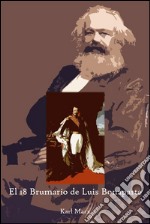
El 18 Brumario de Luis Bonaparte. E-book. Formato EPUB Karl Marx - Karl Marx, 2016 -
El trabajo de Marx El dieciocho Brumario de Luis Bonaparte, escrito basándose en el análisis concreto de los sucesos revolucionarios de Francia entre 1848 y 1851, es una de las obras más importantes del marxismo. En esta obra, Marx analizó la revolución francesa de 1848-1851; desarrolló aún más el principio fundamental del materialismo histórico, la teoría de la lucha de clases y de la revolución proletaria, la doctrina del Estado y de la dictadura proletaria; y llegó por primera vez a la conclusión de que el proletariado triunfante tiene que destruir la máquina del Estado burgués. «Todas las revoluciones han perfeccionado esta máquina —dice—, en lugar de romperla».

Secret diplomatic history. E-book. Formato EPUB Karl Marx - Simone Vannini, 2015 -
To understand a limited historical epoch, we must step beyond its limits, and compare it with other historical epochs. To judge Governments and their acts, we must measure them by their own times and the conscience of their contemporaries. Nobody will condemn a British statesman of the 17th century for acting on a belief in witchcraft, if he find Bacon himself ranging demonology in the catalogue of science. On the other hand, if the Stanhopes, the Walpoles, the Townshends, etc., were suspected, opposed, and denounced in their own country by their own contemporaries as tools or accomplices of Russia, it will no longer do to shelter their policy behind the convenient screen of prejudice and ignorance common to their time. At the head of the historical evidence we have to sift, we place, therefore, long-forgotten English pamphlets printed at the very time of Peter I. These preliminary pièces des procès we shall, however, limit to three pamphlets, which, from three different points of view, illustrate the conduct of England towards Sweden. The first, the Northern Crisis (given in Chapter II.), revealing the general system of Russia, and the dangers accruing to England from the Russification of Sweden; the second, called The Defensive Treaty, judging the acts of England by the Treaty of 1700; and the third, entitled Truth is but Truth, however it is Timed, proving that the new-fangled schemes which magnified Russia into the paramount Power of the Baltic were in flagrant opposition to the traditionary policy England had pursued during the course of a whole century.
Secret diplomatic history. E-book. Formato Mobipocket Karl Marx - Simone Vannini, 2015 -
To understand a limited historical epoch, we must step beyond its limits, and compare it with other historical epochs. To judge Governments and their acts, we must measure them by their own times and the conscience of their contemporaries. Nobody will condemn a British statesman of the 17th century for acting on a belief in witchcraft, if he find Bacon himself ranging demonology in the catalogue of science. On the other hand, if the Stanhopes, the Walpoles, the Townshends, etc., were suspected, opposed, and denounced in their own country by their own contemporaries as tools or accomplices of Russia, it will no longer do to shelter their policy behind the convenient screen of prejudice and ignorance common to their time. At the head of the historical evidence we have to sift, we place, therefore, long-forgotten English pamphlets printed at the very time of Peter I. These preliminary pièces des procès we shall, however, limit to three pamphlets, which, from three different points of view, illustrate the conduct of England towards Sweden. The first, the Northern Crisis (given in Chapter II.), revealing the general system of Russia, and the dangers accruing to England from the Russification of Sweden; the second, called The Defensive Treaty, judging the acts of England by the Treaty of 1700; and the third, entitled Truth is but Truth, however it is Timed, proving that the new-fangled schemes which magnified Russia into the paramount Power of the Baltic were in flagrant opposition to the traditionary policy England had pursued during the course of a whole century.