
London Jack eBooks
eBooks di London Jack editi da Midwest Journal Press di Formato Pdf
Chi cerca i libri di Jack London trova un'immersione profonda nella letteratura d'avventura e nel naturalismo americano, dove la lotta per la sopravvivenza incontra la riflessione filosofica. Seguire i libri in ordine cronologico di Jack London permette al lettore di comprendere l'evoluzione del suo pensiero e il modo in cui l'esperienza diretta nel Klondike ha plasmato la sua potente visione della natura selvaggia.
Biografia dell'autore
Jack London nasce a San Francisco nel 1876. Di origini modeste, vive una giovinezza avventurosa lavorando come marinaio, cercatore d'oro nel Klondike e corrispondente di guerra. Queste esperienze estreme formano la base della sua produzione letteraria, influenzata profondamente dalle teorie di Darwin e Nietzsche. Il suo successo esplode a inizio Novecento grazie a una scrittura cruda e immediata. Si spegne prematuramente nel 1916, lasciando in eredità un corpus di opere che hanno ridefinito il genere del romanzo d'avventura americano, consolidando la sua figura di autore prolifico e icona della letteratura mondiale.
Stile di scrittura
I libri di Jack London si distinguono per uno stile energico, realistico e intriso di una tensione drammatica che mette l'uomo di fronte all'imprevedibilità del mondo naturale. Lo scrittore è celebre per aver creato figure iconiche come Buck, il cane protagonista de Il richiamo della foresta, capace di incarnare il ritorno alle origini selvagge, e Zanna Bianca, che rappresenta il difficile equilibrio tra civiltà e istinto. Attraverso le sue saghe, London esplora l'atavismo e la volontà di potenza, elementi che continuano a esercitare un fascino profondo sui lettori, rendendo le sue opere pietre miliari della narrativa di sopravvivenza.
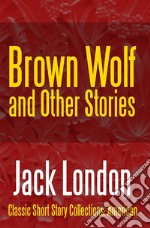
Brown Wolf and Other Stories. E-book. Formato PDF Jack London - Midwest Journal Press, 2017 -
Classic Jack London - Brown Wolf was first published in Everybody's Magazine then later released in this collection by editors who felt a great demand for London's American-pioneer writing style.Also included are; That Spot, Trust, All Gold Canyon, The Story of Keesh, Nam-Bok the Unveracious, Yellow Handkerchief, Make Westing, The Heathen, The Hobo and the Fairy, Just Meat, and A Nose for the King.BROWN WOLF (excerpt)She had delayed, because of the dew-wet grass, in order to put on her overshoes, and when she emerged from the house found her waiting husband absorbed in the wonder of a bursting almond-bud. She sent a questing glance across the tall grass and in and out among the orchard trees."Where's Wolf?" she asked."He was here a moment ago." Walt Irvine drew himself away with a jerk from the metaphysics and poetry of the organic miracle of blossom, and surveyed the landscape. "He was running a rabbit the last I saw of him.""Wolf! Wolf! Here, Wolf!" she called, as they left the clearing and took the trail that led down through the waxen-belled manzanita jungle to the county road.Irvine thrust between his lips the little finger of each hand and lent to her efforts a shrill whistling.She covered her ears hastily and made a wry grimace."My! for a poet, delicately attuned and all the rest of it, you can make unlovely noises. My eardrums are pierced. You outwhistle----""Orpheus.""I was about to say a street-arab," she concluded severely."Poesy does not prevent one from being practical--at least it doesn't prevent me. Mine is no futility of genius that can't sell gems to the magazines."He assumed a mock extravagance, and went on:"I am no attic singer, no ballroom warbler. And why? Because I am practical. Mine is no squalor of song that cannot transmute itself, with proper exchange value, into a flower-crowned cottage, a sweet mountain-meadow, a grove of redwoods, an orchard of thirty-seven trees, one long row of blackberries and two short rows of strawberries, to say nothing of a quarter of a mile of gurgling brook.""Oh, that all your song-transmutations were as successful!" she laughed."Name one that wasn't.""Those two beautiful sonnets that you transmuted into the cow that was accounted the worst milker in the township.""She was beautiful----" he began."But she didn't give milk," Madge interrupted."But she was beautiful, now, wasn't she?" he insisted."And here's where beauty and utility fall out," was her reply. "And there's the Wolf!"...About Jack London:Jack London (1876-1916), was an American author and a pioneer in the then-burgeoning world of commercial magazine fiction. He was one of the first Americans to make a lucrative career exclusively from writing. London was self-educated. He taught himself in the public library, mainly just by reading books. In 1898, he began struggling seriously to break into print, a struggle memorably described in his novel, Martin Eden (1909). Jack London was fortunate in the timing of his writing career. He started just as new printing technologies enabled lower-cost production of magazines. This resulted in a boom in popular magazines aimed at a wide public, and a strong market for short fiction. In 1900, he made $2,500 in writing, the equivalent of about $75,000 today. His career was well under way.
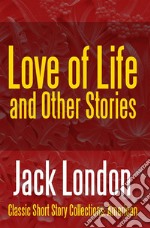
Love of Life & Other Stories. E-book. Formato PDF Jack London - Midwest Journal Press, 2017 -
Jack London was one of the first writers to earn a living in part from his writings in commercial fiction magazines. London became a socialist and his writings reflect this change in his political views. He is best known for his novels The Call of the Wild and White Fang. Stories in this collection include LOVE OF LIFE, A DAY'S LODGING, THE WHITE MAN'S WAY, THE STORY OF KEESH, THE UNEXPECTED, BROWN WOLF, THE SUN-DOG TRAIL, NEGORE, and THE COWARD,LOVE OF LIFE (excerpt)"This out of all will remain - They have lived and have tossed: So much of the game will be gain, Though the gold of the dice has been lost."THEY limped painfully down the bank, and once the foremost of the two men staggered among the rough-strewn rocks. They were tired and weak, and their faces had the drawn expression of patience which comes of hardship long endured. They were heavily burdened with blanket packs which were strapped to their shoulders. Head- straps, passing across the forehead, helped support these packs. Each man carried a rifle. They walked in a stooped posture, the shoulders well forward, the head still farther forward, the eyes bent upon the ground."I wish we had just about two of them cartridges that's layin' in that cache of ourn," said the second man.His voice was utterly and drearily expressionless. He spoke without enthusiasm; and the first man, limping into the milky stream that foamed over the rocks, vouchsafed no reply.The other man followed at his heels. They did not remove their foot-gear, though the water was icy cold - so cold that their ankles ached and their feet went numb. In places the water dashed against their knees, and both men staggered for footing.The man who followed slipped on a smooth boulder, nearly fell, but recovered himself with a violent effort, at the same time uttering a sharp exclamation of pain. He seemed faint and dizzy and put out his free hand while he reeled, as though seeking support against the air. When he had steadied himself he stepped forward, but reeled again and nearly fell. Then he stood still and looked at the other man, who had never turned his head.The man stood still for fully a minute, as though debating with himself. Then he called out:"I say, Bill, I've sprained my ankle."Bill staggered on through the milky water. He did not look around. The man watched him go, and though his face was expressionless as ever, his eyes were like the eyes of a wounded deer.The other man limped up the farther bank and continued straight on without looking back. The man in the stream watched him. His lips trembled a little, so that the rough thatch of brown hair which covered them was visibly agitated. His tongue even strayed out to moisten them."Bill!" he cried out...About Jack London:Jack London (1876-1916), was an American author and a pioneer in the then-burgeoning world of commercial magazine fiction. He was one of the first Americans to make a lucrative career exclusively from writing. London was self-educated. He taught himself in the public library, mainly just by reading books. In 1898, he began struggling seriously to break into print, a struggle memorably described in his novel, Martin Eden (1909). Jack London was fortunate in the timing of his writing career. He started just as new printing technologies enabled lower-cost production of magazines. This resulted in a boom in popular magazines aimed at a wide public, and a strong market for short fiction. In 1900, he made $2,500 in writing, the equivalent of about $75,000 today. His career was well under way.
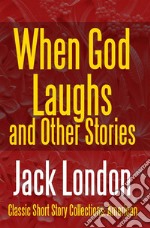
When God Laughs And Other Stories. E-book. Formato PDF Jack London - Midwest Journal Press, 2017 -
Named after the first story about a couple that tries in vain to uphold an intensely idealistic romance against the erosions of time and the inconstancy of human nature the collection explores themes for which London became famous: the struggle for survival in the midst of hostile environments, human nature's most elemental drives, and worker abuse in industrialized society. In The Apostate his concerns with the working poor and his dislike of pre-union-era capitalism are evident in a grim story about a young man who is brutalized by the subhuman working conditions in a textile mill, yet achieves a kind of liberation in the end. London's fascination with primitive male characters is evident in Just Meat, a story of two thieves who plot each other's demise in a selfish grab for a hoard of recently stolen jewelry.Here, in one volume first published in 1911, are a marvelous selection of Jack London's short fiction, including:When God Laughs * The Apostate * A Wicked Woman * "Just Meat" Created He Them * The Chinago * Make Westing * Semper Idem * A Nose for the King The "Francis Spaight" * A Curious Fragment * A Piece of SteakThese outstanding stories--of the sea, of the land, of the ordinary people who work them--are examples of London at this passionate best.About Jack London:Jack London (1876-1916), was an American author and a pioneer in the then-burgeoning world of commercial magazine fiction. He was one of the first Americans to make a lucrative career exclusively from writing. London was self-educated. He taught himself in the public library, mainly just by reading books. In 1898, he began struggling seriously to break into print, a struggle memorably described in his novel, Martin Eden (1909). Jack London was fortunate in the timing of his writing career. He started just as new printing technologies enabled lower-cost production of magazines. This resulted in a boom in popular magazines aimed at a wide public, and a strong market for short fiction. In 1900, he made $2,500 in writing, the equivalent of about $75,000 today. His career was well under way. Among his famous works are: Children of the Frost (1902), The Call of the Wild (1903), The Sea Wolf (1904), The Game (1905), White Fang (1906), The Road (1907), Before Adam (1907), Adventure (1911), and The Scarlet Plague (1912).He was one of the most prolific American writers of the early 20th century, and remains one of the most beloved, but while his novels have remained continuously in print for a century, his short stories have been much harder to find.From a Publisher:"Jack London is at his best - that peculiar best which is inimitable... Nothing is more important to note, however, than the soundness of the psychology of all these stories. They are made out of the deep fibre of humanity. By command over such material does Jack London hold his place in our literature. By command over the knack of clearly flowing, acid-biting English that often takes rich color." - Boston Transcript