
Leo Tolstoy eBooks
eBooks di Leo Tolstoy editi da Skyline
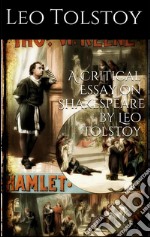
A critical Essay on Shakespeare By LEO TOLSTOY. E-book. Formato EPUB Leo Tolstoy - Skyline, 2015 -
I remember the astonishment I felt when I first read Shakespeare. I expected to receive a powerful aesthetic pleasure, but having read, one after the other, works regarded as his best: "King Lear," "Romeo and Juliet," "Hamlet" and "Macbeth," not only did I feel no delight, but I felt an irresistible repulsion and tedium, and doubted as to whether I was senseless in feeling works regarded as the summit of perfection by the whole of the civilized world to be trivial and positively bad, or whether the significance which this civilized world attributes to the works of Shakespeare was itself senseless. My consternation was increased by the fact that I always keenly felt the beauties of poetry in every form; then why should artistic works recognized by the whole world as those of a genius,—the works of Shakespeare,—not only fail to please me, but be disagreeable to me? For a long time I could not believe in myself, and during fifty years, in order to test myself, I several times recommenced reading Shakespeare in every possible form, in Russian, in English, in German and in Schlegel's translation, as I was advised. Several times I read the dramas and the comedies and historical plays, and I invariably underwent the same feelings: repulsion, weariness, and bewilderment. At the present time, before writing this preface, being desirous once more to test myself, I have, as an old man of seventy-five, again read the whole of Shakespeare, including the historical plays, the "Henrys," "Troilus and Cressida," the "Tempest," "Cymbeline," and I have felt, with even greater force, the same feelings,—this time, however, not of bewilderment, but of firm, indubitable conviction that the unquestionable glory of a great genius which Shakespeare enjoys, and which compels writers of our time to imitate him and readers and spectators to discover in him non-existent merits,—thereby distorting their aesthetic and ethical understanding,—is a great evil, as is every untruth.
A critical Essay on Shakespeare By LEO TOLSTOY. E-book. Formato Mobipocket Leo Tolstoy - Skyline, 2015 -
I remember the astonishment I felt when I first read Shakespeare. I expected to receive a powerful aesthetic pleasure, but having read, one after the other, works regarded as his best: "King Lear," "Romeo and Juliet," "Hamlet" and "Macbeth," not only did I feel no delight, but I felt an irresistible repulsion and tedium, and doubted as to whether I was senseless in feeling works regarded as the summit of perfection by the whole of the civilized world to be trivial and positively bad, or whether the significance which this civilized world attributes to the works of Shakespeare was itself senseless. My consternation was increased by the fact that I always keenly felt the beauties of poetry in every form; then why should artistic works recognized by the whole world as those of a genius,—the works of Shakespeare,—not only fail to please me, but be disagreeable to me? For a long time I could not believe in myself, and during fifty years, in order to test myself, I several times recommenced reading Shakespeare in every possible form, in Russian, in English, in German and in Schlegel's translation, as I was advised. Several times I read the dramas and the comedies and historical plays, and I invariably underwent the same feelings: repulsion, weariness, and bewilderment. At the present time, before writing this preface, being desirous once more to test myself, I have, as an old man of seventy-five, again read the whole of Shakespeare, including the historical plays, the "Henrys," "Troilus and Cressida," the "Tempest," "Cymbeline," and I have felt, with even greater force, the same feelings,—this time, however, not of bewilderment, but of firm, indubitable conviction that the unquestionable glory of a great genius which Shakespeare enjoys, and which compels writers of our time to imitate him and readers and spectators to discover in him non-existent merits,—thereby distorting their aesthetic and ethical understanding,—is a great evil, as is every untruth.

The Devil. E-book. Formato EPUB Tolstoy Leo - Skyline, 2022 -
Towards the end of 1880, when he was fifty-two, Tolstoy one day approached the young tutor who lived in his house at Yasnaya Polyana, and in great agitation asked him to do him a service. The tutor, seeing Tolstoy so moved, asked what he could possibly do for him. In an unready voice Tolstoy replied: "Save me, I am falling!" The tutor, in alarm, inquired what was the matter, to which Tolstoy replied: "I am overcome by sexual desire and feel a complete lack of power to retrain myself. I am in danger of yielding to the temptation. Help me!" "I am a weak man myself," replied the tutor. "How can I help you?" "You can, if only you won't refuse!" "But what must I do to help you?" "This! Come with me on my daily walks. We will go out together and talk, and the temptation will not occur to me."