
Paolo Rossi eBooks
eBooks di Paolo Rossi editi da Pisa University Press
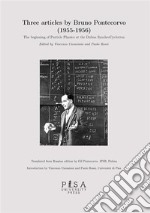
Three articles by Bruno Pontecorvo (1955-1956)The beginning of Particle Physics at the Dubna SynchroCyclotron. E-book. Formato PDF Paolo Rossi - Pisa University Press, 2020 -
This volume presents three papers by Bruno Pontecorvo translated from the original Russian edition. The physics results discussed in the papers have been obtained by Pontecorvo in the years 1955-56 at the synchrocyclotron of Dubna, in USSR, a proton accelerator that, at that time, was the most powerful particle-machine in the world. Thanks to the large energy available, important results have been obtained using secondary beams of charged pions interacting with hydrogen and deuterium. A detailed analysis of the data collected is presented in terms of the theoretical models available at that time, based on “Partial Waves Analysis” of the interaction cross sections. Moreover, a reanalysis of the negative-pion- proton cross-sections presented in the introduction, proves the existence of the Δ0-baryon particle, a member of the baryonic decuplet of the SU(3) symmetry group. The Δ-baryon family (Δ++, Δ+, Δ0, Δ-) represented an important milestone for the following developments in particle physics: the Gell-Mann Zweig quark-model and the introduction of the “color”: the new quantum number of the strong interaction theory: the “Quantum Chromodynamics”. Translated from Russian edition by Gil Pontecorvo, JINR, Dubna Introduction by Vincenzo Cavasinni and Paolo Rossi, Universit´a di Pisa
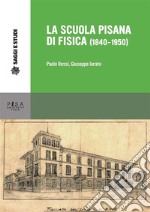
La scuola pisana di Fisica (1840-1950). E-book. Formato PDF Rossi Paolo Iurato Giuseppe - Pisa University Press, 2018 -
La scuola pisana di Fisica (1840-1950). E-book. Formato PDF - Pisa University Press
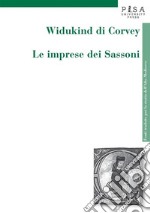
Widukind di Corvey - Le imprese dei Sassoni. E-book. Formato PDF Paolo Rossi - Pisa University Press, 2021 -
Dopo la disgregazione dell’impero carolingio, il X secolo è segnato da una riaffermazione di poteri locali che hanno spesso una forte base etnica. Contro questa tendenza si ergono i duchi sassoni, giunti al titolo di re di Germania. Enrico I e il figlio Ottone I sviluppano una coerente strategia di rafforzamento del potere regio, contenendo le spinte centrifughe che sfruttano anche ì conflitti interni alla famiglia dei sovrani, ed esercitando un forte contrasto nei confronti dei nemici esterni. Il monaco Widukind segue da vicino queste vicende, e ce ne riporta dettagli importanti ma non reperibili altrove. La sua testimonianza è quindi fondamentale per una più ampia comprensione delle dinamiche in atto in una fase storica in cui si vanno definendo gli assetti geopolitiici dell’intera Europa.Introduzione, traduzione e note a cura di Paolo Rossi