
John Stuart Mill eBooks
eBooks di John Stuart Mill di Formato Mobipocket Economia
Utilitarianism (Centaur Classics). E-book. Formato Mobipocket John Stuart Mill - Angelo Pereira, 2015 -
How do we decide what is "good" and what is "bad"? According to the ethical theory of Utilitarianism, to do good is to "always perform that act, of those available, that will bring the most happiness or the least unhappiness." By far the most widely read introduction to this theory, John Stuart Mill's "Utilitarianism" is one of the most important and controversial works of moral philosophy ever written.In this major contribution to ethical history, Mill's treatise defends the view that all human action should produce the greatest happiness overall, and that happiness itself is made up of "higher pleasures," such as the cultural, intellectual, and spiritual, and "lower pleasures," such as the physical. The relationship of utilitarian theory to other ethical systems, and powerful arguments in its favor—especially when concerning justice—are brilliantly discussed. How do we weigh options to maximize happiness for self and for those around us? From common-day dilemmas to large-scale social decisions, this exposition remains as relevant today as it was to intellectual and moral dilemmas of the nineteenth century.
Utilitarianism. E-book. Formato Mobipocket John Stuart Mill - John Stuart Mill, 2015 -
Philosopher, son of James Mill, born in London, was educated by his father with the view of making him the successor of Bentham and himself, as the exponent of the Utilitarian philosophy. In all respects he proved an apt pupil, and by his 15th year had studied classical literature, logic, political economy, and mathematics. In that year he went to France, where he was under the charge of Sir S. Bentham, a brother of Jeremy. His studies had led him to the adoption of the utilitarian philosophy, and after his return he became acquainted with Grote, the Austins, and other Benthamites. In 1823 he entered the India House as a clerk, and, like his father, rose to be examiner of Indian correspondence; and, on the dissolution of the Company, retired on a liberal pension. In 1825 he edited Bentham’s Rationale of Judicial Evidence. During the following years he was a frequent contributor to Radical journals, and edited the London Review. His Logic appeared in 1843, and produced a profound impression; and in 1848 he published Principles of Political Economy. The years between 1858 and 1865 were very productive, his treatises on Liberty, Utilitarianism, Representative Government, and his Examination of Sir W. Hamilton’s Philosophy being published during this period. In 1865 he entered the House of Commons as one of the members for Westminster, where, though highly respected, he made no great mark. After this political parenthesis he returned to his literary pursuits, and wrote The Subjection of Women [1869], The Irish Land Question [1870], and an Autobiography. Mill had married in 1851 Mrs. Taylor, for whom he showed an extraordinary devotion, and whom he survived for 15 years. He died at Avignon. His Autobiography gives a singular, and in some respects painful account of the methods and views of his father in his education. Though remaining all his life an adherent of the utilitarian philosophy, Mill did not transmit it to his disciples altogether unmodified, but, finding it too narrow and rigid for his own intellectual and moral requirements, devoted himself to widening it, and infusing into it a certain element of idealism.
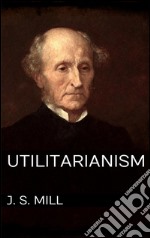
Utilitarianism. E-book. Formato Mobipocket John Stuart Mill - Pubme, 2015 -
The creed which accepts as the foundation of morals, Utility, or the Greatest Happiness Principle, holds that actions are right in proportion as they tend to promote happiness, wrong as they tend to produce the reverse of happiness. By happiness is intended pleasure, and the absence of pain; by unhappiness, pain, and the privation of pleasure. To give a clear view of the moral standard set up by the theory, much more requires to be said; in particular, what things it includes in the ideas of pain and pleasure; and to what extent this is left an open question. But these supplementary explanations do not affect the theory of life on which this theory of morality is grounded—namely, that pleasure, and freedom from pain, are the only things desirable as ends; and that all desirable things (which are as numerous in the utilitarian as in any other scheme) are desirable either for the pleasure inherent in themselves, or as means to the promotion of pleasure and the prevention of pain.Now, such a theory of life excites in many minds, and among them in some of the most estimable in feeling and purpose, inveterate dislike. To suppose that life has (as they express it) no higher end than pleasure—no better and nobler object of desire and pursuit—they designate as utterly mean and grovelling; as a doctrine worthy only of swine, to whom the followers of Epicurus were, at a very early period, contemptuously likened; and modern holders of the doctrine are occasionally made the subject of equally polite comparisons by its German, French, and English assailants.