
Roberto Diodato eBooks
eBooks di Roberto Diodato di Formato Epub Filosofia: estetica
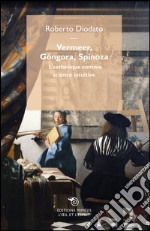
Vermeer, Góngora, Spinoza: L'esthétique comme science intuitive. E-book. Formato EPUB Roberto Diodato - Editions Mimésis, 2016 -
Dans les tableaux de Vermeer, comme l’Art de la peinture, la Vue de Delft ou la Jeune lle avec la perle, et dans les Soledades de Góngora, on représente, dans l’intensité d’une vision qui est à la fois – et de façon inextricable – perception sensible et intelligence, raison et imagination, la dignité des choses en elles-mêmes. Pour appréhender cette intensité, il est toutefois nécessaire de faire un tour ample, qui, depuis l’étude des notions fondamentales de la pensée de Spinoza (fini et infini, temps et éternité, unité et multiplicité, corps et esprit, ordre, perfection, beauté), arrive jusqu’à une interprétation de la science intuitive, c’est-à-dire de cette modalité particulière de l’expérience qui est à la fois connaissance, joie, puissance de l’imagination.
The Sensible Invisible: Itineraries in Aesthetic Ontology. E-book. Formato EPUB Roberto Diodato - Mimesis International, 2016 -
The itineraries traced by this book investigate the ontological and metaphysical sense of aesthetic experience. This latter is here understood as the primary experience through which our whole existence as human beings is endowed with the world and can manifest itself. Readers will find two different yet convergent intentions. The first, exquisitely concerned with ontology and aesthetics, develops Merleau-Ponty’s theory on flesh as element in the direction of an ontology of virtuality.Its main aim is to fully grasp a new entity surfacing on the background of being, which is, properly speaking, neither living nor artificial. The second, mainly concerned with aesthetics and metaphysics, pinpoints entities’ power of being within the aesthetic-linguistic experience of deixis while accounting for the work of the aesthetic logos as a condition of possibility for metaempirical inferences.