
Carlo Nofri eBooks
eBooks di Carlo Nofri di Formato Epub
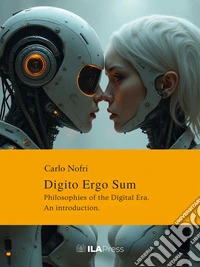
Digito ergo SumPhilosophies of the digital era. An introduction - English Edition. E-book. Formato EPUB Nofri Carlo - Edizioni Ila Press, 2026 -
The volume represents an attempt to provide an up-to-date picture of the scientific and philosophical debate that is accompanying the development of the digital revolution.On the one hand, pervasive technological innovations and whose prodigiously beneficial effects are emphasized daily by the media, on the other hand the growing and widespread concerns aroused in public opinion and in governments by the opaque methods of use of these technologies that take hold even before the actual impact on human life can be examined.A tension between pro-digital fanaticism and techno-skepticism that so far has made the victim first of all the possibility of discussing it a priori and not always a posteriori, that is, before things happen and not after.This revolution, emblematically symbolised by Artificial Intelligence, is producing unprecedented contradictions, here defined antinomies, which are the cause of a growing collective disorientation and thorny philosophical dilemmas. In all of them the advent of a new dimension of human living, the infosphere, which redefines the identities, now plural and digital, of each individual.A world in which people participate as virtual characters, or avatars, and the Cartesian “cogito ergo sum”, an ancient ontological proof of existence for Homo Sapiens Sapiens, is replaced by another ontology, that of Homo Sapiens Digitans that can be summarized in a new axiom: digito ergo sum.Hence the need for a new philosophical anthropology that can guide us towards this future full of questions. A Glossary at the end of the volume, with the explanation of some key terms, accompanies the reader on the journey.
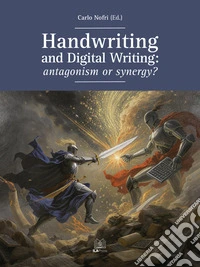
Handwriting and digital writing: antagonism or synergy?. E-book. Formato EPUB Carlo Nofri - Edizioni Ila Press, 2026 -
This volume brings together the contributions from the conference of the same name, which posed this question to Italian and international experts from various disciplines: linguists, psychiatrists, graphologists, calligraphers, historians of writing, neuroscientists, and educators. A common thread seems to connect all the contributions: handwriting, particularly cursive writing, is under threat globally, both in terms of learning and practice. Moreover, there is a widespread and creeping sense of obsolescence that now surrounds its perception, even in public opinion, in the face of the “digital deluge” affecting every aspect of social life and educational practices. On one hand, we have the triumphant civilization of the internet, digital devices, and distance learning, a lifeline for schools during the terrible years of the Covid-19 pandemic, symbols of modernity and progress that have promised and continue to promise more accessible education and easier forms of learning. On the other hand, we have paper, pens, and books, traditional tools for accessing writing and reading, which now seem to rhyme with outdated technologies of the past.But is this truly the case? Does the digital revolution really lead to better educational outcomes? Are we sure it’s time to retire notebooks, pens, and printed books in favor of keyboards, screens, and digital hypertexts? The findings and studies presented in this volume suggest exactly the opposite, calling instead for a new synthesis between humanistic knowledge and digital technologies that is yet to be fully realized.