
Patrick Macgill eBooks
eBooks di Patrick Macgill di Formato Pdf
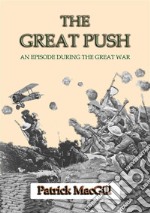
THE GREAT PUSH - An Episode on the Western Front during the Great War. E-book. Formato PDF Patrick Macgill - Abela Publishing, 2017 -
By 1915 the trenches of the Western Front were in different states of repair, including the captured trenches, which had all but been destroyed as a result of shell fire. The countryside and villages were a scene of utter devastation, nothing but mud and mounds of rubble where communities and fields of wheat had once stood. The main battles during 1915 were Ypres, French Flanders, Artois, Aisne, Champagne and Vosges. During September and October 1915 an attack by French and British forces from Vimy Ridge to La Bassée, was called the Artois-Loos Offensive or the Third Battle of Artois. This novella by Patrick MacGill, the 5th of 20, is based on his experiences in the trenches of Loos during this period, which resulted in arguably his best book on World War One. A classic of war literature, The Great Push could be considered autobiographical in nature and is nevertheless a passionate and compelling book which describes the fear, resilience, humour and fatalism of those who fought in the raw edge of one of the most terrifying wars ever to have been waged. MacGill had somehow penned all but the last two chapters in the trenches of Loos before being wounded. He wrote the last two chapters while recovering in hospital in the latter part of 1915. =============== Patrick MacGill 1889 – 1963, was an Irish journalist, poet and novelist, known as "The Navvy Poet" because he had worked as a navvy before he began writing. During the First World War, MacGill served with the London Irish Rifles (1/18th Battalion, The London Regiment) and was wounded at the Battle of Loos on 28 October 1915. He was recruited into Military Intelligence, and wrote for MI 7b between 1916 and the Armistice in 1918. During his lifetime he penned 20 novels, 5 volumes of poetry and 2 plays.

THE DIGGERS - The Australians in FranceFREE eBook. E-book. Formato PDF Patrick Macgill - Abela Publishing, 2018 -
In this small ebook, are but nine chapters which give an Australian perspective of their time spent on the Western Front in France. The imperishable deeds of the Commonwealth’s glorious soldiers, least of all the Australians, or Diggers, have carved for themselves a deep niche in the topmost towers of the Temple of the Immortals. The story of the valour of the Diggers will live throughout the ages, and future generations of Australians will speak of them as we do of all the heroic figures of antiquity. Their valour has covered Australia with a lustre that shines throughout the world, so that her name, which in 1914 was little known, by 1918 had become a household word in the mouths of all the peoples of the earth. The Great War made Australia—a young community without traditions—a nation, acutely and proudly conscious of its nationality. Upon that day some hundred years gone, when in the grey of early dawn the first Australian soldier leapt upon an unknown shore and in the face of a murderous fire scaled the heights of Gaba Tepe—a feat of arms almost unparalleled in the history of war—the young Australian Community put on the toga of nationhood, and in one stride entered on a footing equal to any other nation in the family of free nations of the earth. Gallipoli—scene of that most glorious attempt which though falling short of the promised success, lost nothing of its greatness—thy name is and forever will be held sacred to all! When Gallipoli had been given up as a forlorn hope, the soldiers of the Commonwealth were relocated to Europe’s Western Front, when in the Spring of 1918 the great German offensive pressed back and by force of numbers broke through the sorely tried British line, the Australian divisions were hurried down from the North and rushed up to stem the German armies. The story of the battles fought by the Australians before Amiens is amongst the most thrilling in the history of this great world conflict. Here the fate of civilization was decided. The great German army, marching along the road in column of route, like the armies of Napoleon a hundred years before, reached the crest of high land overlooking Amiens, and with but a few miles between them and the key to Paris, were held up by a veritable handful of Australians, later reinforced as the rest of the Divisions came to hand. It was the turning of the tide; the fighting raged around Villers-Bretonneux, but the car of the German Juggernaut rolled forward no more. An impassable barrier had been set up beyond which the enemy could not pass. But the young soldiers of Australia, not satisfied with arresting his onward march, began to force the Hun back; at first slowly, and then faster and faster, until in the great offensive of August 8, when along with four Divisions of Canadians and two British, they swept him back in headlong rout, nor gave him pause until breaking through the vaunted Hindenburg line they stood victorious at Beaurevoir. The deeds of these brave men will remain forever fresh in the minds of the Commonwealth and Allied nations. Australia has reason to be proud of her war effort; she has done great things; but she has paid a great price. That a small community of just five million recruited and sent 330,000 men twelve thousand miles across the seas, is a great thing. The number dead—57,000—with total casualties—289,723—show how great the price Australia paid for Liberty. Indeed, it was the “new” colonies of South Africa, New Zealand, Australia and Canada which paid a heavy price in war dead. It would only be another 21 years before they would be asked to pay yet again. 10% of the profit from the sale of this book will be donated to charities by the publisher.
The Rat-Pit. E-book. Formato PDF Patrick Macgill - Forgotten Books, 2017 -
In the city of Glasgow there is a lodging-house for women known as "The Rat-pit." Here the vagrant can get a nightly bunk for a few pence, and no female is refused admittance: the unfortunate, the sick, and work-weary congregate under the same roof, breathe the same fetid air and forget the troubles of a miserable existence in strong drink, the solace of the sorrowful, or in heavy stupor, the slumber of the toilworn. The underworld, of which I have seen and known such a lot, has always appeared to me as a Greater Rat-pit, where human beings, pinched and poverty-stricken and ground down with a weight of oppression, are hemmed up like the plague-stricken in a pest-house.It is in this larger sense that I have chosen the name for the title of Norah Ryan's story. By committing the "great sin" and subsequently by allowing the dictates of motherhood to triumph over decrees of society, she became a pariah eternally doomed to the Greater Rat-pit. Whilst my former book, "Children of the Dead End," was on the whole accepted as giving a picture of the life of the navvy, there were some who refused to believe that scenes such as I strove to depict could exist in a country like ours. To them I venture the assurance that "The Rat-pit" is a transcript from life and that most of the characters are real people, and the scenes only too poignantly true.