
Rafael Jimenez Catano eBooks
eBooks di Rafael Jimenez Catano di Formato Epub

Beauty and Life: Exploring the anthropology behind the fine arts. E-book. Formato EPUB Rafael Jiménez Cataño - Edusc, 2021 -
In architecture, height and mass have a wonderful effect because they suggest immediately a relation to the sphere on which the structure stands, and so to the gravitating system. The tower which with such painful solidity soars like an arrow to heaven apprizes me in an unusual manner of that law of gravitation, by its truth to which it can rear aloft into the atmosphere those dangerous masses of granite, and keep them there for ages as easily as if it were a feather or a scrap of down (Ralph Waldo Emerson, Life and Literature, lecture 2: Art). “Become a great artist. That is the only way to justify what you are doing to everyone’s life.” […] I did not understand what he meant. I did not feel I had to justify anything... I did not want to paint in order to justify anything, I wanted to paint because I wanted to paint. I wanted to paint the same way my father wanted to travel and work for the Rebbe. My father worked for Torah. I worked for— what? How could I explain it? For beauty? No. Many of the pictures I painted were not beautiful. For what, then? For a truth I did not know how to put into words. For truth I could only bring to life by means of color and line and texture and form (Chaim Potok, My Name is Asher Lev). The pantheon of art is not a timeless presence which offers itself to pure aesthetic consciousness but the assembled achievements of the human mind as it has realised itself historically. Aesthetic experience also is a mode of self-understanding. But all self-understanding takes place in relation to something else that is understood and includes the unity and sameness of this other. Inasmuch as we encounter the work of art in the world and a world in the individual work of art, this does not remain a strange universe into which we are magically transported for a time. Rather, we learn to understand ourselves in it, and that means that we preserve the discontinuity of the experience in the continuity of our existence. Therefore it is necessary to adopt an attitude to the beautiful and to art that does not lay claim to immediacy, but corresponds to the historical reality of man (Hans-Georg Gadamer, Truth and Method). Texts by Federica Bergamino, Michela Cortini, Juan José García-Noblejas, Rafael Jiménez Cataño, Giuseppe Madonna, Juan Carlos Mansur, Silvana Noschese, Jaana Parviainen, Giampiero Pizzol, Fulvia Strano.

Ragione e persona nella persuasione: Testi su dialogo e argomentazione. E-book. Formato EPUB Rafael Jiménez Cataño - Edusc, 2020 -
La dimostrazione e il ragionamento formale possono avere validità in sé, senza riferimento a un destinatario. L’efficacia della persuasione non può invece essere studiata nella sua completezza senza sapere cosa rappresenti il parlante per l’interlocutore, senza tener conto delle circostanze in cui l’argomentazione si svolge. La verità è debole almeno in due aspetti molto evidenti: a) è possibile possedere la verità senza poterlo dimostrare (quante volte abbiamo vissuto l’esperienza di avere ragione senza che gli altri lo abbiano riconosciuto?); b) con la verità (con proposizioni vere) si può ingannare, corrompere, diseducare: la disinformazione più efficace è di solito quella che non dice altro che verità. Si dice che alla fine la verità vinca sempre: sono convinto che sia così, e Aristotele assicura che «la verità e la giustizia sono per natura più forti dei loro contrari». Tuttavia, se non vogliamo aspettare fino al giudizio universale, dobbiamo dotare la verità di maggior vigore. I due aspetti della sua debolezza ci riportano alla nozione aristotelica di retorica, «la facoltà di scoprire il possibile mezzo di persuasione riguardo a ciascun soggetto», che a me piace ridefinire “l’arte di far sì che la verità sembri vera”. Non è poco! Che cosa non darebbe un genitore per essere in grado di presentare ai figli le cose in modo tale che essi le vedano nella maniera adeguata? Che cosa non darebbe un maestro? Che cosa non darebbe uno che si accinge a dichiarare il suo amore? Rafael Jiménez Cataño è Professore Ordinario della Facoltà di Comunicazione Istituzionale della Pontificia Università della Santa Croce, a Roma. Fra i suoi libri, La debilidad del poder creador (2006, sulla creazione artistica) e Lo desconocido es entrañable.Arte y vida en Octavio Paz (2008). La sua ricerca nell’ambito tematico di questo volume si riflette nell’insegnamento (soprattutto nei corsi di Retorica e di Logica) e nei convegni sul dialogo e l’argomentazione, in particolare quelli organizzati da Ergo, Associazione di Pratica e Teoria dell’Argomentazione, dall’International Association for Dialogue Analysis e dall’International Association for the Study of the Controversies,associazioni di cui è membro. Legata a questi soggetti è anche la sua regolare collaborazione con riviste come Ixtus (Messico), per la quale cura la rubrica “La bendición de Babel”. Fra i testi presentati ai convegni, non inclusi in questa raccolta, possiamo segnalare: “Negotiating meanings: the appeal to dictionaries” (Tel Aviv, 1999),“Separating vs. uniting distance in Chicano speech” (Göteborg, 2001, in collaborazione con I. García Martínez), “Monologue and dialogue in politeness choices” (Salzburg, 2003), “Historia e identidad en Octavio Paz: la libertad ante las libertades” (Viseu, 2005), “Dialogo dei saperi” (Palermo, 2006), “What does sentimentalism mean? Emotive meaning in some elliptic and a fortiori argumentations” (Milano, 2008), “Buona e cattiva retorica nel dibattito sulla vita e la morte in Italia” (Roma, 2010), “Risorse per gestire stereotipi e fenomeni simili” (Padova, 2010), “Literary Text’s Freedom and ist Encounter with the Reader” (Turku, 2012).
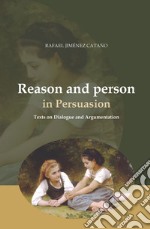
Reason and Person in Persuasion: Texts on Dialogue and Argumentation. E-book. Formato EPUB Rafael Jiménez Cataño - Edusc, 2020 -
This volume brings together articles and conference papers on dialogue, politeness and argumentation, with a philosophical perspective that consists of exploring anthropological perspectives of themes in rhetoric and linguistics, going into the structure of the person behind logical and communicative acts Rafael Jiménez Cataño is full professor of the Communication School of the University of the Holy Cross, in Rome. Philosophy doctor, his research in the thematic area of this volume is reflected in the classrooms and in conferences on dialogue, argumentation and rhetoric. He currently heads the project Rhetoric & Anthropology, which he began with colleagues of several countries in 2015.