
Wilfred Owen eBooks
eBooks di Wilfred Owen di Formato Pdf
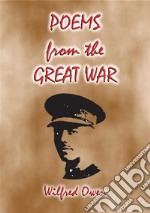
POEMS (from the Great War) - 23 of WWI's best poems. E-book. Formato PDF Wilfred Owen - Abela Publishing, 2017 -
Wilfred Edward Salter Owen, MC (18 March 1893 – 4 November 1918) was an English poet and soldier, is considered to be one of the greatest poets of WWI. His war poetry on the horrors of trenches and gas warfare was heavily influenced by his mentor Siegfried Sassoon, and stood in stark contrast both to the public perception of war at the time and to the confidently patriotic verse written by earlier war poets such as Rupert Brooke. Herein you will 23 find such poems, like “Anthem for Doomed Youth,” “Dulce et Decorum est.,” “Spring Offensive,” “Futility” and others that lament the passing of so many in such dire circumstances. “Anthem for Doomed Youth,” is one of the most perfectly structured of Owen’s poems, It convinced Sassoon in October 1917 that Owen was not only a “promising minor poet” but a poet with “classic and imaginative serenity” who possessed “impressive affinities with Keats.” Owen was killed in action on 4 November 1918 during the crossing of the Sambre–Oise Canal, exactly one week (almost to the hour) before the signing of the Armistice which ended the war, and was promoted to the rank of Lieutenant the day after his death. His mother received the telegram informing her of his death on Armistice Day (11 Nov.), as the church bells were ringing out in celebration.
Poems. E-book. Formato PDF Wilfred Owen - Ionlineshopping.Com, 2019 -
Introduction In writing an Introduction such as this it is good to be brief. The poems printed in this book need no preliminary commendations from me or anyone else. The author has left us his own fragmentary but impressive Foreword; this, and his Poems, can speak for him, backed by the authority of his experience as an infantry soldier, and sustained by nobility and originality of style. All that was strongest in Wilfred Owen survives in his poems; any superficial impressions of his personality, any records of his conversation, behaviour, or appearance, would be irrelevant and unseemly. The curiosity which demands such morsels would be incapable of appreciating the richness of his work. The discussion of his experiments in assonance and dissonance (of which 'Strange Meeting' is the finest example) may be left to the professional critics of verse, the majority of whom will be more preoccupied with such technical details than with the profound humanity of the self- revelation manifested in such magnificent lines as those at the end of his 'Apologia pro Poemate Meo', and in that other poem which he named 'Greater Love'. Wilfred Owen was born at Oswestry on 18th March 1893. He was educated at the Birkenhead Institute, and matriculated at London University in 1910. In 1913 he obtained a private tutorship near Bordeaux, where he remained until 1915. During this period he became acquainted with the eminent French poet, Laurent Tailhade, to whom he showed his early verses, and from whom he received considerable encouragement. In 1915, in spite of delicate health, he joined the Artists' Rifles O.T.C., was gazetted to the Manchester Regiment, and served with their 2nd Battalion in France from December 1916 to June 1917, when he was invalided home. Fourteen months later he returned to the Western Front and served with the same Battalion, ultimately commanding a Company. Contents Preface -- Strange meeting -- Greater love -- Apologia pro Poemate Meo -- The show -- Mental cases -- Parable of the old men and the young -- Arms and the boy -- Anthem for doomed youth -- The send-off -- Insensibility -- Dulce et decorum est -- The sentry -- The dead-beat -- Exposure -- Spring offensive -- The chances -- S.I.W. -- Futility -- Smile, smile, smile -- Conscious -- A terre -- Wild with all regrets -- Disabled -- The end.