
Europa Edizioni eBooks
eBooks editi da Europa Edizioni Giurisprudenza e argomenti d'interesse generale

Un uomo solo al comando: Piccola guida per rispettare l’ordine emanato da una sentenza. E-book. Formato EPUB Severino Diamanti - Europa Edizioni, 2018 -
Sì! Dopo lunghi anni di attesa giustizia è fatta. Con roboanti e tronfie frasi essa scende in prima linea. Non più Tocchi e Toghe, non più sorde aule, non più rassicuranti messaggi come “La legge è uguale per tutti” ma due avvocati uno trionfante per aver vinto, l’altro livoroso in quanto ha perso. Molto spesso non si tratta di una decisione giusta ma deve essere eseguita. I nostri padri latini affermavano: Summum ius, summa iniuria. È una locuzione latina il cui significato letterale è “somma giustizia, somma ingiustizia”, oppure “il massimo del diritto, il massimo dell’ingiustizia”. Cicerone (De officiis, I, 10, 33) la cita come espressione proverbiale. Una espressione analoga si trova infatti già in Terenzio (Heautontimorumenos, IV, 5): Ius summum saepe summa est malitia “somma giustizia equivale spesso a somma malizia”. Affermazione che io ho sempre condiviso in quanto a prescindere dal caso concreto, che può essere stato giustamente valutato, il fatto che la decisione arrivi dopo un numero di anni eccessivo, produce “ingiustizia” e sicuramente anche la “malizia” ha contribuito alla dilatazione dei tempi.
Un uomo solo al comando: Piccola guida per rispettare l’ordine emanato da una sentenza. E-book. Formato Mobipocket Severino Diamanti - Europa Edizioni, 2018 -
Sì! Dopo lunghi anni di attesa giustizia è fatta. Con roboanti e tronfie frasi essa scende in prima linea. Non più Tocchi e Toghe, non più sorde aule, non più rassicuranti messaggi come “La legge è uguale per tutti” ma due avvocati uno trionfante per aver vinto, l’altro livoroso in quanto ha perso. Molto spesso non si tratta di una decisione giusta ma deve essere eseguita. I nostri padri latini affermavano: Summum ius, summa iniuria. È una locuzione latina il cui significato letterale è “somma giustizia, somma ingiustizia”, oppure “il massimo del diritto, il massimo dell’ingiustizia”. Cicerone (De officiis, I, 10, 33) la cita come espressione proverbiale. Una espressione analoga si trova infatti già in Terenzio (Heautontimorumenos, IV, 5): Ius summum saepe summa est malitia “somma giustizia equivale spesso a somma malizia”. Affermazione che io ho sempre condiviso in quanto a prescindere dal caso concreto, che può essere stato giustamente valutato, il fatto che la decisione arrivi dopo un numero di anni eccessivo, produce “ingiustizia” e sicuramente anche la “malizia” ha contribuito alla dilatazione dei tempi.
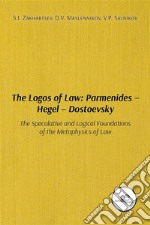
The Logos of Law: Parmenides – Hegel – Dostoevsky. E-book. Formato EPUB S.I. Zakhartsev - Europa Edizioni, 2021 -
This monograph develops an extensively fresh approach for interpreting logical philosophy as a way to understand the universal unity of thinking and being (Fichte and Hegel) and interpreting the meaning of its harmony (Dostoevsky). The book offers a starting, easy-to-read overview of the essence and meaning of the universal unity of thought and being, as a core concept of the classical philosophy—from the teachings of Parmenides to those of the early Christian Fathers—and the philosophy of law, that tries to demonstrate how this universal unity, which is the foundation of the absolute harmony of existence, manifests in itself the certainty of law and legal awareness. Gradually, it proceeds to introduce increasingly difficult aspects of the German philosophy of 18th–19th centuries by presenting a synthesis of the logical form of philosophy until landing in metaphysics of law, as well as major long-term issues of modern jurisprudence. The authors present a specialized knowledge about law as a complex and multidimensional notion; they discuss the problem of monism-dualism, look at the law-morality, law-religion dualisms and at the concept of the Absolute in law. Their approach is aimed to develop theoretical and methodological premises of a modern, comprehensive theory of law based on an updated notion of freedom in law. This paper synthesizes the results that this trio of researchers, regarded as experts by the Russian scientific community, has achieved after many years of systematic studies of philosophy of law. It is addressed to specialists in the field of theory and philosophy of law, university tutors, post-graduate students, graduate students, legal experts and to everyone who is interested in improving their knowledge of history of philosophy and legal thought as well as exploring Dostoevsky’s ideas from an unusual perspective.