
Pisa University Press eBooks
eBooks editi da Pisa University Press di Genere Linguistica
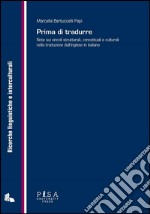
Prima di tradurre: Note sui vincoli strutturali, concettuali e culturali nella traduzione dall’inglese in italiano. E-book. Formato PDF Marcella Bertuccelli Papi - Pisa University Press, 2016 -
Queste Note non insegnano a tradurre bensì propongono alcune osservazioni come spunti per una riflessione sui vincoli strutturali, concettuali e culturali nella traduzione dall’inglese all’italiano. Si può tradurre in tanti modi, per scopi diversi e con risultati di diversa qualità. Una buona traduzione è spesso il frutto di un talento innato, di un istinto ma, come in tutti i campi del sapere, la riflessione, la ponderazione delle scelte, la consapevolezza della materia con la quale si opera e dei meccanismi del suo funzionamento sono indispensabili per raggiungere risultati stabili e duraturi. Sebbene la traduzione sia una forma raffinata di comunicazione e mediazione interculturale che richiede sensibilità ad una pluralità di aspetti linguistici ed extralinguistici, la prospettiva qui adottata è prevalentemente linguistica: la traduzione è vista cioè dalla prospettiva di due sistemi linguistici comparabili ma anche divergenti in alcune aree della loro organizzazione. Tali divergenze rappresentano vincoli con i quali lo studente dovrà fare costantemente i conti nella pratica traduttiva: acquisirne consapevolezza può essere d’aiuto nel processo di formazione del giovane traduttore.
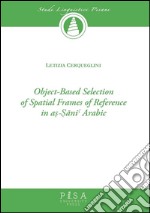
Object-based selection of spatial frames of reference in a?-?ani? Arabic. E-book. Formato PDF Letizia Cerqueglini - Pisa University Press, 2015 -
In 2003, S.C. Levinson defined spatial Frames of Reference as semantic and cognitive strategies used to project coordinate systems onto spatial arrays, in order to conceptualize and linguistically describe angular relations. Since then, several descriptions of referential styles worldwide have been produced, mostly focused on the language-to-cognition correlation, within the dispute between Universalism and Determinism. Such an intellectual dichotomy is being overtaken by historical and structuralist approaches to spatial semantics and cognition. Since all three Frames of Reference are in use among the elderly a?-?ani? speakers (Negev Nomadic Arabic), this work accounts for the strategies underlying the distribution of the Relative Frame of Reference, and of its sub-category ‘Aligned Field’, monitoring the collapse of the Aligned Field from the language of the elderly to that of the young generation. Thanks to culture-specific stimuli, the experiments reveal that elderly a?-?ani? speakers use object-specific referential and prepositional strategies, based on a culture-specific and domain-related ontology of entities. Young people, acquainted to sedentary life, urban spaces and objects of modern life, do not retain the old ontology, developing a different set of referential strategies and restructuring the prepositional system. This study shows how the cultural dimension shapes the spatial experience and the embodiment of spatial grammar, proposing a radically Relativistic approach. The supposedly universal mutual independence of ‘what’ and ‘where’ concepts should be re-discussed on a cultural basis, since the nature and effects of the relationship between language and cognition may represent themselves cross-cultural variables.