
S eBooks
eBooks di Titolo S editi da Midwest Journal Press di Formato Epub

Snow Gift. E-book. Formato EPUB C. C. Brower - Midwest Journal Press, 2018 -
A farmer out checking his cattle finds a newborn calf of many colors.Deep in fresh snow with no momma cow in sight. It is supposed to get well below freezing tonight and the sun is going down quickly. What choice does he have but to pick the newborn up and get her to where it's warm and dry for the night? ...And then come back in the dark to find its mother. 40 pounds of calf a quarter of a mile from anywhere. So he wraps her up in his coat, picks her up, and starts trudging through the snow back to his farmhouse. But a couple of spirits were waiting for him to arrive... Excerpt: It was supposed to be a time of peace. No conflicts beyond fighting with the weather for crops and rebuilding our society. Better than that, there were outside forces adding to that mix. Spirits and demons and stuff. I didn't know all that when I was checking the cows that winter day. Just my dogs and me. Seeing how the fences were, making sure the calves were on the right side of them. Not that there was much conflict or worry from those cattle. Even coyotes left them alone. Nothing like a mean momma cow. They were never far from their young calves. And wolves were only up north. Hunters made them scarce in this state. So when I saw the calico calf in the snow, it was surprising. The cows were black and white, no red or brown in them. Not in several generations, anyway. Not with this bull. And the neighbor's haven't been out of their fences into ours. Now I'd heard of striped cows, and spotted cows, but those were in two colors. This was three. Like a cat. Or more like a kitten. There was this calf. New born. Shivering. No cow tracks anywhere. Just fresh snow on top of old snow. Still below freezing. Means I had to get this calf somewhere warm. Closest place was a quarter-mile away. Carrying a forty-pound calf. So I took off my outer coat to wrap up that calf. (Layers helped in more ways than one - besides, I'd be sweating shortly hefting this weight up and down hills.) And I'd still have to warm up some colostrum and milk-replacer. And come back to find that mother cow and bring her up to wherever I got the calf safely. I had some hundreds of other thoughts going through about what I now had to do. Like the many fences I'd have to cross with this calf, where to keep it warm that I could clean up. How much it was going to take to get another cow to take it in. My day had just been changed. One bright spot was that it was still morning. That bright spot was dimming though. The sky was becoming dark, but without any clouds. I could hardly see my own tracks to make my way back. I didn't want to stumble with this precious bundle in my arms. And that slowed me down as I had to be more careful. There wasn't even a moon to light my way. This was becoming quite a chore. And I thought I was used to farm chores. "Are you sure this is the one?" "You've read the same signs. The stars, the loneliness, the remoteness. He's the future." "The future that is yet to be, hundreds of years in the future." "But only if we act now." "Right. Let's do this." Bonus Story: "Mr. Ben's Rail Road" where an entrepreneur is working to re-establish a working railroad between the farmers and the city just miles away. A young girl, along with her father and cousins, are allowed to ride along for the adventure. She's recording everything for history, just in case... Get Your Copy Now!
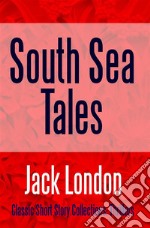
South Sea Tales. E-book. Formato EPUB Jack London - Midwest Journal Press, 2017 -
South Sea Tales (1911) is a collection of short stories written by Jack London. Most stories are set in island communities, like those of Hawaii, or are set aboard a ship. These are darker Pacific tales, including "Mauki" and "The Terrible Solomans."MAUKI (excerpt)He weighed one hundred and ten pounds. His hair was kinky and negroid, and he was black. He was peculiarly black. He was neither blue-black nor purple-black, but plum-black. His name was Mauki, and he was the son of a chief. He had three tambos. Tambo is Melanesian for taboo, and is first cousin to that Polynesian word. Mauki's three tambos were as follows: First, he must never shake hands with a woman, nor have a woman's hand touch him or any of his personal belongings; secondly, he must never eat clams nor any food from a fire in which clams had been cooked; thirdly, he must never touch a crocodile, nor travel in a canoe that carried any part of a crocodile even if as large as a tooth.Of a different black were his teeeth, which were deep black, or, perhaps better, LAMP-black. They had been made so in a single night, by his mother, who had compressed about them a powdered mineral which was dug from the landslide back of Port Adams. Port Adams is a salt-water village on Malaita, and Malaita is the most savage island in the Solomons--so savage that no traders or planters have yet gained a foothold on it; while, from the time of the earliest bache-de-mer fishers and sandalwood traders down to the latest labor recruiters equipped with automatic rifles and gasolene engines, scores of white adventurers have been passed out by tomahawks and soft-nosed Snider bullets. So Malaita remains today, in the twentieth century, the stamping ground of the labor recruiters, who farm its coasts for laborers who engage and contract themselves to toil on the plantations of the neighboring and more civilized islands for a wage of thirty dollars a year. The natives of those neighboring and more civilized islands have themselves become too civilized to work on plantations.Mauki's ears were pierced, not in one place, nor two places, but in a couple of dozen places. In one of the smaller holes he carried a clay pipe. The larger holes were too large for such use. The bowl of the pipe would have fallen through. In fact, in the largest hole in each ear he habitually wore round wooden plugs that were an even four inches in diameter. Roughly speaking, the circumference of said holes was twelve and one-half inches. Mauki was catholic in his tastes. In the various smaller holes he carried such things as empty rifle cartridges, horseshoe nails, copper screws, pieces of string, braids of sennit, strips of green leaf, and, in the cool of the day, scarlet hibiscus flowers...About Jack London: Jack London (1876-1916), was an American author and a pioneer in the then-burgeoning world of commercial magazine fiction. He was one of the first Americans to make a lucrative career exclusively from writing. London was self-educated. He taught himself in the public library, mainly just by reading books. In 1898, he began struggling seriously to break into print, a struggle memorably described in his novel, Martin Eden (1909). Jack London was fortunate in the timing of his writing career. He started just as new printing technologies enabled lower-cost production of magazines. This resulted in a boom in popular magazines aimed at a wide public, and a strong market for short fiction. In 1900, he made $2,500 in writing, the equivalent of about $75,000 today. His career was well under way. Among his famous works are: Children of the Frost (1902), The Call of the Wild (1903), The Sea Wolf (1904), The Game (1905), White Fang (1906), The Road (1907), Before Adam (1907), Adventure (1911), and The Scarlet Plague (1912).
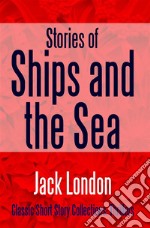
Stories of Ships and the Sea. E-book. Formato EPUB Jack London - Midwest Journal Press, 2017 -
A collection of Jack London sea stories.CHRIS FARRINGTON: ABLE SEAMAN (Excerpt)"If you vas in der old country ships, a liddle shaver like you vood pe only der boy, und you vood wait on der able seamen. Und ven der able seaman sing out, 'Boy, der water-jug!' you vood jump quick, like a shot, und bring der water-jug. Und ven der able seaman sing out, 'Boy, my boots!' you vood get der boots. Und you vood pe politeful, und say 'Yessir' und 'No sir.' But you pe in der American ship, and you t'ink you are so good as der able seamen. Chris, mine boy, I haf ben a sailorman for twenty-two years, und do you t'ink you are so good as me? I vas a sailorman pefore you vas borned, und I knot und reef und splice ven you play mit topstrings und fly kites.""But you are unfair, Emil!" cried Chris Farrington, his sensitive face flushed and hurt. He was a slender though strongly built young fellow of seventeen, with Yankee ancestry writ large all over him."Dere you go vonce again!" the Swedish sailor exploded. "My name is Mister Johansen, und a kid of a boy like you call me 'Emil!' It vas insulting, und comes pecause of der American ship!""But you call me 'Chris'!" the boy expostulated, reproachfully."But you vas a boy.""Who does a man's work," Chris retorted. "And because I do a man's work I have as much right to call you by your first name as you me. We are all equals in this fo'castle, and you know it. When we signed for the voyage in San Francisco, we signed as sailors on the Sophie Sutherland and there was no difference made with any of us. Haven't I always done my work? Did I ever shirk? Did you or any other man ever have to take a wheel for me? Or a lookout? Or go aloft?""Chris is right," interrupted a young English sailor. "No man has had to do a tap of his work yet. He signed as good as any of us and he's shown himself as good—""Better!" broke in a Novia Scotia man. "Better than some of us! When we struck the sealing-grounds he turned out to be next to the best boat-steerer aboard. Only French Louis, who'd been at it for years, could beat him. I'm only a boat-puller, and you're only a boat-puller, too, Emil Johansen, for all your twenty-two years at sea. Why don't you become a boat-steerer?"...About Jack London: Jack London (1876-1916), was an American author and a pioneer in the then-burgeoning world of commercial magazine fiction. He was one of the first Americans to make a lucrative career exclusively from writing. London was self-educated. He taught himself in the public library, mainly just by reading books. In 1898, he began struggling seriously to break into print, a struggle memorably described in his novel, Martin Eden (1909). Jack London was fortunate in the timing of his writing career. He started just as new printing technologies enabled lower-cost production of magazines. This resulted in a boom in popular magazines aimed at a wide public, and a strong market for short fiction. In 1900, he made $2,500 in writing, the equivalent of about $75,000 today. His career was well under way. Among his famous works are: Children of the Frost (1902), The Call of the Wild (1903), The Sea Wolf (1904), The Game (1905), White Fang (1906), The Road (1907), Before Adam (1907), Adventure (1911), and The Scarlet Plague (1912).