
Libri di Susan Keen
Bibliografia di Susan Keen: tutti i libri in vendita online
Su Unilibro trovi i libri di Susan Keen in vendita online: scopri la bibliografia dell'autore, le ultime uscite e le offerte disponibili.
Consulta la cronologia dei libri di Susan Keen, scegli il titolo che ti interessa, aggiungilo al carrello e completa l'acquisto in pochi clic.

Integrated principles of zoology Hickman Cleveland P. Keen Susan L. Eisenhour David J. - Mcgraw-Hill Education, 2022 - Scienze
Integrated principles of zoology - McGraw-Hill Education
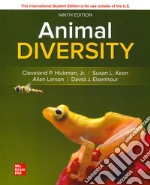
Animal diversity Hickman Cleveland P. Keen Susan L. Larson Allan - Mcgraw-Hill Education, 2022 - Scienze
The beautiful yellow tree frog on our cover is an amphibian, as are salamanders and caecilians. Despite the common name, not all tree frogs live in trees and, while some have evolved direct development and colonized very dry places, most amphibians inhabit moist regions and rely on water for larva! development. Amphibian populations have been in decline since the 1970s: 32% of amphibian species were threatened and 43% were in decline by 2004. Among the first threats to be identified was loss of wetland and other habitats, but disease is now critically important. A chytrid fungus in the genus Batrachochytrium decimates populations around the globe, spreading rapidly via the global pet trade. Two parasites, a trematode whose presence causes deformed limbs, and a nematode that causes kidney damage, are also reducing amphibian survival. Amphibians are the final host for trematodes, but the trematodes live and multiply inside snails first. An increase in snail populations is an indirect effect of applying the herbicide atrazine in large-scale crop production. Amphibians are key components of complex ecosystems, serving as both predators and prey. Recent global insect declines create a new vulnerability for amphibians, while in turn, loss of amphibians has led to declines in tropical snakes, which feed heavily on frogs. Humans often feel more kinship with mammals than with amphibians, but we can draw on our iconic childhood experiences such as collecting tadpoles and chasing frogs to connect with amphibians. Funding habitat protection, using pesticides only as necessary, and encouraging responsible trade in pets will all benefit these animals.